|
|
Many friends who are new to Pu'er tea often ask the same question: why is Pu'er tea specifically pressed into cakes or bricks, unlike green tea, black tea, and oolong tea, which mostly exist in loose-leaf form?
The core value of Pu'er tea lies in post-fermentation. Loose tea has a large surface area exposed to air, leading to rapid oxidation and intense but unstable microbial activity—resulting in over-transformation on the surface while the inner tea remains unchanged. This uneven process can cause a tea to quickly lose its structural integrity within three to five years.
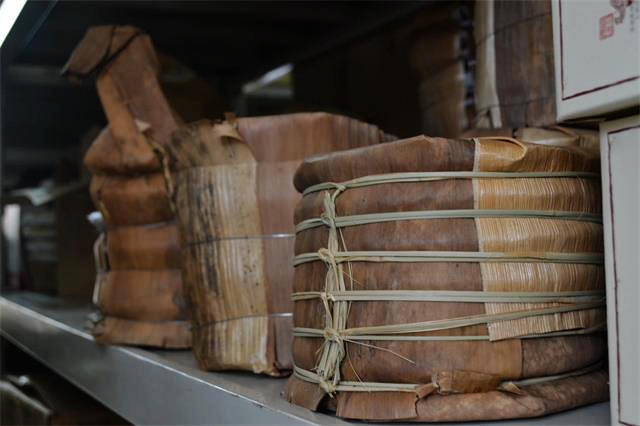
After being pressed into cakes or bricks, the tea leaves form a relatively dense yet porous structure. The advantage of this structure lies in its ability to neither be entirely sealed nor completely open. Oxygen slowly seeps in, moisture is evenly distributed, and microorganisms undergo prolonged, gentle interactions in a stable temperature and humidity environment.
As the storage period extends, the drawbacks of loose tea become apparent. Aroma compounds gradually dissipate through continuous exposure to air, while the richness and complexity of the tea liquor begin to decline after a certain point. More importantly, the transformation trajectory of loose tea is highly unpredictable—even from the same batch, tea stored in different jars or locations may exhibit vastly different states after several years.
A well-pressed and securely stored Pu'er tea cake is, in itself, a reply from time.
|
|

 English
 简体中文
简体中文

 Post time 2026-8-3 14:17:52