|
|
Tea enthusiasts often receive free loose tea from merchants or purchase some loose Pu'er tea. When brewed initially, it tastes excellent and aromatic. But after being pressed into cakes, where does the previous fragrance go? Why isn’t it as fragrant as before? What’s the reason for this?
First, let's talk about loose-leaf Pu'er tea. Fresh leaves are picked from tea plantations, then undergo withering and high-temperature rolling to deactivate enzymatic reactions, which is why the tea retains its green hue after fixation. The leaves are then sun-dried (hence the name "sun-dried raw tea"), a process lasting about eight hours. Freshly sun-dried tea has the most intense cooling properties and delivers the strongest flavor, especially with its elevated aroma in loose-leaf form. Thus, some tea drinkers find it too cold and unaccustomed, while others appreciate its rich fragrance and find it delightful.
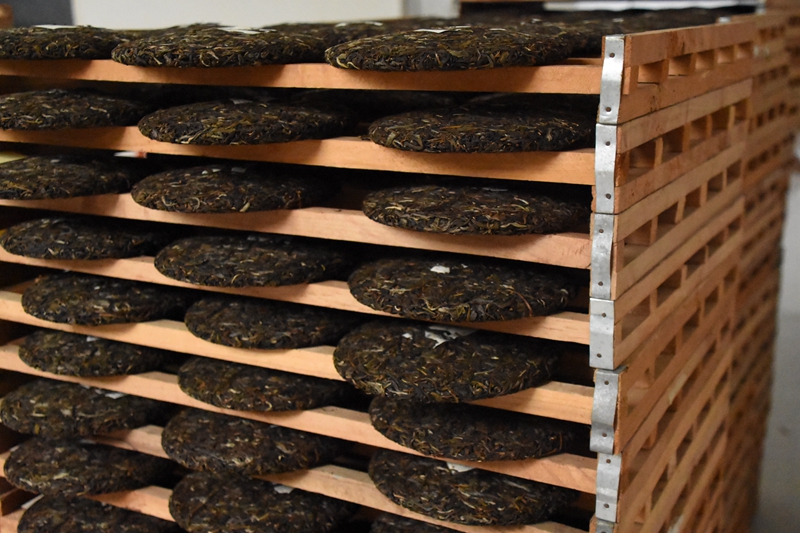
Once loose tea is steamed and pressed into cakes, its fragrance settles deeper, and many tea enthusiasts feel it's no longer the same tea. This is not surprising, as Pu'er tea is inherently a versatile product. Depending on the passage of time, storage conditions, and variations in processing techniques, it can exhibit diverse flavors. This is precisely why Pu'er tea becomes more aromatic with age, and its charm lies in its endless transformations.
So, what causes this change? It is because when loose tea is compressed into tea cakes, it must first undergo high-temperature steaming to soften and moisten, allowing the tea leaves to be shaped. During this process, the tea absorbs a significant amount of moisture. Under the influence of high temperatures, Pu'er tea undergoes a minor transformation, resulting in a milder character compared to loose-leaf tea, while its aroma diminishes due to moisture absorption.
After the tea leaves are formed and left to cool and dry for a period, the moisture dissipates, and the aroma gradually intensifies. Simultaneously, as the tea leaves are shaped and compressed by gravity, the internal essence is extracted from the cell walls, resulting in a more pronounced flavor and character compared to loose-leaf tea. This refers solely to the performance of the same tea variety at different stages, and different tea varieties are not comparable.
|
|

 English
 简体中文
简体中文

 Post time 2026-7-18 15:12:25