|
|
Why do people find ripe Pu'er tea relatively thick? It may be due to three factors:
One is the fragrance type
In terms of fragrance profile, the new Pu'er tea leans towards a light and fresh aroma, typically lingering at the stage of grass and floral notes, with at most a hint of fresh fruity fragrance, gently wafting in the nose.
The aroma of ripe Pu'er tea is a deep, fermented fragrance, typically dominated by a mellow, earthy scent. It carries a rich, steady aroma that lingers firmly in the nose.
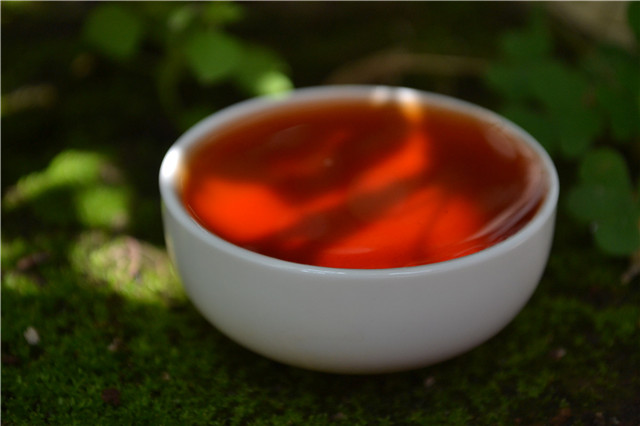
One is the concentration of the tea infusion
Raw Pu'er tea emphasizes the richness and structure of its internal qualities, while ripe Pu'er tea focuses on sweetness, thickness, and smoothness. Raw Pu'er possesses many subtle sensory dimensions, such as throat coolness, saliva stimulation, tooth-sensing, and aftertaste, which require careful sipping to fully appreciate. In contrast, ripe Pu'er processes many of these internal qualities into a singular sweetness and a thick, liquid sensation, making it appear more intense in terms of singular expression.
One is the texture of the tea liquor.
Sheng Pu'er has a characteristic of being somewhat astringent, which is a unique attribute inherent to this post-naturally fermented tea. If two identical tea infusions are compared—one with a hint of this astringency and the other without—it would make the astringent one seem thinner in texture. Most people cannot distinguish between the astringency and the intrinsic quality of the tea infusion when tasting. In contrast, ripe Pu'er tea is largely free of astringency, thus avoiding any perception of thinness in its texture.
|
|

 English
 简体中文
简体中文

 Post time 2026-6-30 14:01:47