|
|
Ripe Pu'er tea and black tea are often referred to as the "warm tea twins" by tea enthusiasts.
But interestingly, some people start to wonder while drinking: both are fully fermented teas with similar colors, so why does aged tea taste rich and mellow while black tea is sweet and fruity? What exactly sets them apart?
The production of black tea follows the classic process of "withering → rolling → fermentation → drying." After the fresh leaves are harvested, they are first withered to soften, then rolled to break the cell structure. At this stage, the polyphenol oxidase within the leaves "goes into action," catalyzing the oxidation of tea polyphenols, gradually transforming them into theaflavins and thearubigins. This gives rise to the iconic "red liquor and red leaves" characteristic of black tea.
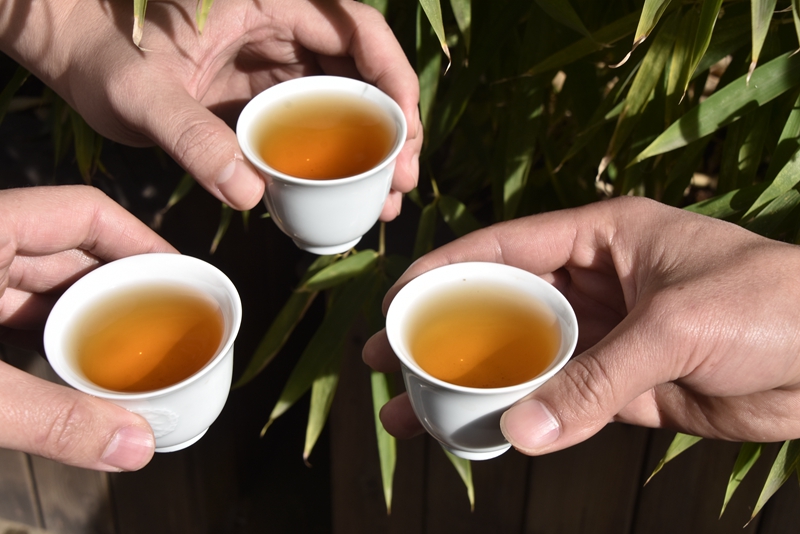
Pu'er ripe tea follows an entirely different path. Its starting point is not fresh leaves but sun-dried raw tea—meaning the green tea material made from Yunnan large-leaf tea leaves that have already been sun-dried. Since raw tea has low moisture content and cannot ferment on its own, it requires manual watering to increase humidity before being piled up for "heap fermentation.".
At this point, the main actors are not enzymes but a group of diligent microorganisms. They multiply extensively in the tea pile, generate heat, and vigorously break down cell walls, transforming substances like tea polyphenols and catechins into large amounts of tea brown pigment. As a result, the brewed tea often exhibits a deeper, darker red hue, carrying a steady "aged flavor.".
Remember the difference with one sentence:
Black tea relies on "enzymes" for processing, while ripe tea depends on "bacteria" for fermentation.
|
|

 English
 简体中文
简体中文

 Post time 2026-6-9 13:47:42