|
|
To determine whether a new raw Pu'er tea (freshly made raw Pu'er) has aging potential, one cannot rely solely on terms like "ancient trees" or "famous tea mountains" on the packaging, nor can they make conclusions based solely on how delicious it tastes at the moment.
The aging of raw Pu'er tea is essentially a slow reaction involving the oxidation and polymerization of tea polyphenols, the transformation of astringent substances, the recombination of sugars and aromatic compounds, the thickening of the tea's texture, and the shift from vibrant to mellow aroma. While fresh tea may impress with its brilliance, it may not necessarily age into a vintage brew; conversely, tea that appears somewhat greenish may still possess hidden depth.
Let’s start with the raw materials. Among the major tea-producing regions in Yunnan, such as Menghai, Yiwu, Lincang, and Pu'er, teas with genuine long-term aging potential typically exhibit the following characteristics: plump leaves, distinct leaf veins, moderate downy coverage, excellent tenderness retention, and elastic tea stems. These fresh leaves contain a more complete array of compounds—well-balanced proportions of tea polyphenols, catechins, amino acids, caffeine, polysaccharides, pectin, and flavonoids.
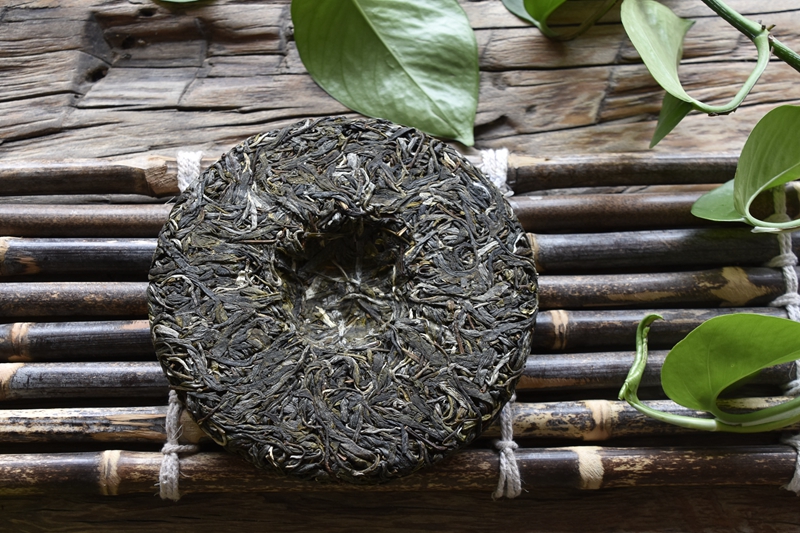
Now, let's look at the craftsmanship. The aging potential of raw Pu'er tea comes equally from the raw materials and the preservation through fixation and sun-drying. Four key steps—low-temperature slow fixation, uniform pan temperature, fixation to achieve "neither raw nor scorched," moderate rolling, and natural sun-drying—must be executed properly. Only by avoiding the thermal death of the tea's enzyme system can the later oxidation process serve as the "engine.".
The texture of the tea liquor is a dimension easily overlooked by beginners. The "thickness" can be discerned even in fresh tea: does the tea taste like milky water or plain boiled water? Teas with aging potential, even if they are astringent when fresh, exhibit a sense of "substance clinging to the tongue." After swallowing, there's a film-like sensation on the oral palate, and the sweetness doesn't emerge abruptly but gradually seeps out as saliva + sweetness + coolness.
So don’t be fooled by "startling first sip" or deterred by "bitter new tea." Look for vibrant leaves, whether bitterness fades, depth in the brew, a lingering aftertaste, and stability in body—pass these five tests, and even if it’s not from a renowned mountain, it’s worth keeping a few cakes.
|
|

 English
 简体中文

 Post time